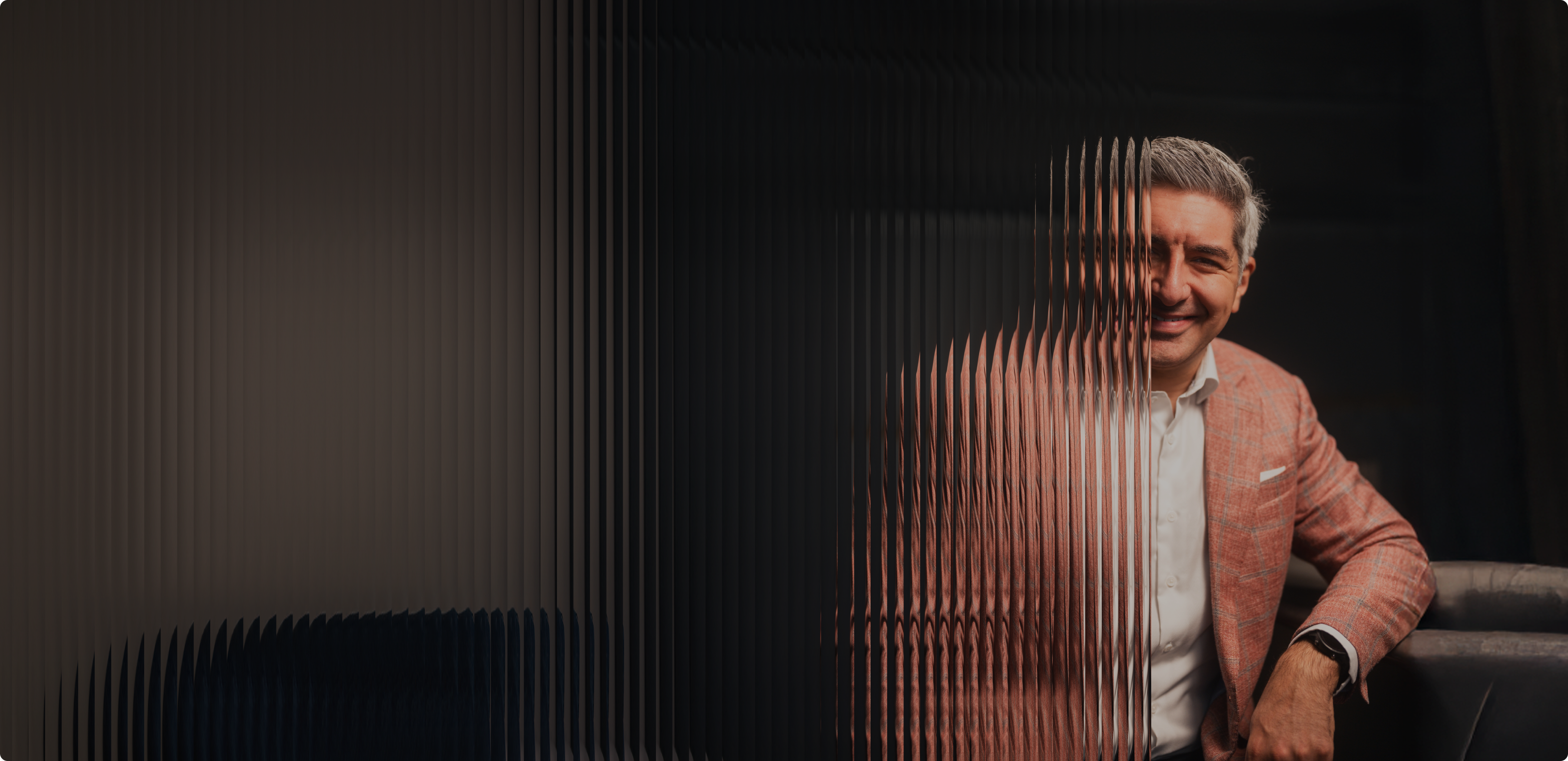
Interview - Henri Arslanian (Nine Blocks Cap.)
 14 min read
"Our kids will ask us how it was when Bitcoin was only $100,000"
It was in the elegant Hôtel Château Voltaire, nestled between Les Invalides and the Louvre, that we set the scene for our meeting with Henri Arslanian. Henri is the co‑founder and managing partner of Nine Blocks Capital Management, an institutional‑grade crypto hedge fund based in Dubai and the first of its kind to be licensed by the emirate’s VARA regulator .
A cosmopolitan figure in every imaginable sense, Henri was born in Montreal to an Armenian family and later broadened his horizons in Hong Kong, where he launched Asia’s first university‑level fintech & crypto course at the University of Hong Kong in 2015. Before founding Nine Blocks, he served as PwC’s global crypto leader, advising top exchanges, investors, financial institutions, and even governments and central banks, on digital asset initiatives and policies .
Henri’s accomplishments extend beyond finance and academia. With over half a million followers on LinkedIn, he is a TEDx and global keynote speaker, best‑selling author of books like The Book of Crypto and The Future of Finance, and a recognized thought leader featured in major media outlets from Bloomberg to the Financial Times.
Our conversation touched on the roots of his fascination with Bitcoin, shaped by his immersive, global background and his belief that digital assets hold the promise of a universally accessible currency, not bound by borders, languages, or societal privilege. What followed was a candid, wide-ranging discussion, from early crypto memories to reflections on regulation, stablecoins, tokenization, and the future of money.
CoinShares: What first sparked your interest in crypto?
Henri Arslanian: I grew up in Canada. I moved to China afterwards and I was in Hong Kong. In Hong Kong I started my career as a lawyer. I was a hedge fund lawyer and then I was in banking. I was doing prime brokerage. And I remember looking at the trading floor, looking at the bank and saying why do we need so many humans? And those years were the early days of Fintech. Fintech was just a term that people were starting to use and I just got curious into it. And then that’s how I discovered Bitcoin. Literally I discovered Bitcoin in 2013.
I remember reading about a guy , a French guy actually , setting up a crypto exchange in Hong Kong. And I said wow, this Bitcoin thing that I’ve been reading about… And then in 2014, in the first quarter, I organized my first Bitcoin event in Hong Kong at the Canadian Chamber of Commerce called Bitcoin Could Be the Future of Money.
To give an idea, at the time after organizing the event the Canadian Chamber of Commerce got a number of complaints saying “What is Henri Arslanian doing with this money laundering thing? It affects the reputation of the chamber.” And the rest is history. I got into it, I really started reading about it and fell into that rabbit hole. In 2016, when I joined PwC, we set up the crypto team. Initially it was me and a one-page business plan, and obviously the team grew , we were over 400 people in 25 countries. Since 2016 I’ve been in it full-time professionally, and I enjoy every second of it.
You were born in Montreal, Canada. I think that your family background comes from Armenia. You studied in Hong Kong, China. Now you live in Dubai. Do you think that made you more in tune with the concept of global currency such as Bitcoin?
The world is a very interesting place, right? I was very fortunate growing up in Montreal, becoming bilingual, having an Armenian background, and obviously living in China, speaking Chinese, and living in Hong Kong. I saw a lot from a global perspective.
What I really find interesting with Bitcoin from that global perspective is the potential of having something truly decentralized. If you look through history at different leaders, governments, and empires, often the biggest flaws are not the technology, but mistakes that leaders make. There’s something beautiful in Bitcoin in that you don’t need to trust people , you trust code, you trust mathematics.
Overall, what attracts me to the digital asset space is that it allows everybody to have access. The most shocking thing in finance is that the one thing you have no control over , where you’re born , has a huge impact on the financial services you can access.
If somebody today is born in Iran or North Korea, something they have no control over, they’re cut off from global financial services. They didn’t choose their government or birthplace. Why are we cutting entire populations off? That’s what I like about decentralized digital currencies , they enable inclusion. I’m a big believer the world is very global, and changing fast in geopolitics, economics, and financial markets.
You mentioned the perception of Bitcoin 10 years ago. It was quite dangerous for your own reputation. So what made you stick to it?
It’s difficult for people entering crypto today to understand the headaches we had early on. For example, when I bought my first Bitcoin in Hong Kong, there was a Bitcoin ATM, and an exchange called ANX (now OSL). We’d literally go give them cash to buy crypto.
The first time I bought Bitcoin, I had to wire money to Kraken’s exchange in Japan, to a bank account in Tokyo, just to access the exchange. It was difficult just to buy digital assets.
But that was the least of the problems. As soon as a bank knew you held crypto, they’d cut you off. I’ve seen entrepreneurs lose their companies because banks closed their accounts with three days’ notice. It’s happened to me multiple times , banks I had accounts with would call to say, “Mr. Arslanian, we’re shutting down your accounts.” They wouldn’t tell me why, but later I’d hear it was because I was a PwC partner in charge of crypto or active in industry events.
The beauty of Bitcoin is its decentralization; the problem with Bitcoin is also its decentralization. There’s no CEO or PR agent for Bitcoin, so when something negative happens, the media can easily cover it in a bad light. Nobody reports that every 10 minutes a block is created and the network runs perfectly, or that people can transfer money globally 24/7. But scandals make headlines.
Because of that, crypto has a bad name. We’re not at the stage where everyone understands Bitcoin or digital assets. One of our biggest challenges is education , I believe we all have a duty to educate people so they can make informed decisions.
You’re bridging the gap between traditional finance and crypto. Do you ever feel like you’re translating between worlds that don’t speak to each other?
Things have changed a lot in recent years. I’ve been a professor at the University of Hong Kong since 2015, teaching the world’s first crypto university class. I’ve published multiple books, including books for kids. I’ve trained regulators, central banks, and bank executives.
The biggest difficulty isn’t teaching , most people can grasp the basics in a few hours. The bigger challenge is the mental barrier, the prejudice of “this is a money laundering thing.”
My advice: instead of flowers for Christmas, New Year’s, or Valentine’s Day, give a bit of digital assets. It’s a great conversation starter, and it teaches people how to transfer and custody crypto.
There’s also a generational gap. When I speak to older board members or CEOs, I tell them to ask their kids or nephews about Bitcoin, stablecoins, DeFi, or NFTs. They’re often surprised to learn their family is active in crypto.
The younger generation doesn’t want to deal with banks that close on weekends. It’s ridiculous that in 2025 we can’t do many financial transactions over the weekend, and that sending money internationally costs an average of 7%. I can send a message or make a call instantly for free, but money transfers are slow and expensive. Digital assets can change that, though there are still challenges.
Generally, once people understand it, that’s half the battle.
As you said, you do a lot of financial education. What is the most misunderstood thing about Bitcoin according to you?
The two things I hear most from the average person on the street: “Bitcoin is used by criminals” and “It’s anonymous.” That’s the language we often hear, largely from the mass media.
What shocks people the most after learning more is how traceable and public Bitcoin transactions are. Every single Bitcoin transaction in the world is publicly available. You don’t know the names behind the addresses, but you can see that transactions happened.
Half-jokingly, I say if you’re a criminal using Bitcoin, you’re an idiot, you will get caught eventually.
Where we have a lot of work to do is in educating the younger generation. I recently published a comic book for kids about crypto. I learned kids’ books need superheroes, rhymes, and female characters, it was hard work! But I believe the generation most impacted by these changes will be today’s youth.
It’s unacceptable that we’re not teaching kids in school about digital assets, Bitcoin, and the transformations taking place in money, especially since they will be the ones living with these changes.
Let’s talk about Nine Blocks Capital Management, your hedge fund. What is the thesis behind it?
I’ve been in the hedge fund space for many years: I started as a hedge fund lawyer, then worked in prime brokerage. I believe many institutional investors will enter crypto, but initially they will do so through regulated fund managers or platforms.
That’s how Nine Blocks was born. The idea was to build a business that generates consistent, risk-adjusted returns, while being regulated and operating to the highest global standards.
Today, four years in, we’ve had market-leading returns. We are the first and only crypto hedge fund licensed by the VARA regulator in Dubai , probably the most difficult regulator to deal with , and we’ve built an institutional-grade business that investors want. Was it easy? Absolutely not. But I believe it’s the way to go.
Why did you pick Dubai to obtain your license?
Over the years I’ve worked with many regulators and central banks, helping draft crypto rules in places from Hong Kong to the Bahamas to the Middle East.
What’s interesting about Dubai is that it created the world’s first crypto-specialized regulator a couple of years ago, when the U.S. market was closed. The industry is novel, complex, and unique, and Dubai recognized that.
Today, as a crypto hedge fund, most of my counterparties are within a one-minute walk from me. The Dubai regulator now has hundreds of applications pending, and most major firms have obtained licenses there. Dubai has become a global crypto hub.
The UAE as a whole , including Abu Dhabi, Ras Al Khaimah, and other emirates , seized this opportunity. Different emirates attract different types of firms: Abu Dhabi for some asset managers, DIFC for traditional managers entering crypto, Dubai’s VARA for crypto-native firms, Ras Al Khaimah for non-regulated activities.
Dubai provided what the industry has always asked for: clear regulations and a level playing field.
How important is due diligence to operating a hedge fund, especially a crypto hedge fund?
Very important. Many of our investors are making their first crypto allocation, so the sales process is long, with extensive due diligence, both on the investment side and the operational side.
Operational diligence means ensuring the business runs to international standards: having the right service providers, auditors, technology, governance, independent directors, whitelisting addresses, and managing risk.
I’m proud that Nine Blocks often ranks as the number one crypto hedge fund for operational diligence. Whatever is possible in a tier-one traditional hedge fund, we try to replicate in a crypto hedge fund.
Yes, investors want great returns, but they also don’t want a blow-up caused by operational issues. Strong investment and operational due diligence are critical.
How would you rate regulations across different markets?
As a lawyer, I’m fascinated by crypto policy. Done properly, it can be a huge catalyst for the industry. The UAE is a prime example , three years ago it had little crypto activity, now it has thousands of firms.
In Asia, Hong Kong has put frameworks in place, but I’d argue they’re now too stringent. Singapore is on the other extreme , if you’re only doing crypto, in many cases there’s no regulation.
In Europe, MiCA will create a “European bubble” where firms get licensed for that market.
In the Middle East, VARA in Dubai, Abu Dhabi, and Ras Al Khaimah attract firms wanting a global hub. From a time zone and infrastructure perspective, you can cover the world from the UAE. I’m extremely bullish on the UAE as a global crypto hub.
The big market to watch is the U.S. , how and if its regulations change will determine what firms move there or return.
It’s not just regulation , stability, security, taxes, and visas matter. You need to be able to attract talent. Countries with vision, agility, and execution will win. The UAE has those qualities, so I remain very bullish.
What do you think about the current state of tokenization? Is it hype or does it have a future?
We’ve called it many things over the years, security tokens, tokenization, now “real-world assets.” I was extremely bullish in 2018–2020, and I was wrong about the timing. I expected slow movement, but recently things have moved faster than I thought.
I’m pleasantly surprised at the growing interest. Tokenisation makes sense , otherwise huge segments of investors are excluded due to minimums. For example, I can’t buy an entire commercial building, but I could buy $100,000 worth of it if tokenised.
The question is where tokenization will happen. Some countries are experimenting with real estate titles, others with treasuries. The funds industry is a good example, I’m convinced that in the next few years, many fund units will be bought as tokenized instruments.
What’s your take on the increasing adoption of stablecoins?
Stablecoins are probably the killer use case we’ve had in crypto. To put it in perspective , on January 1st, 2020, there was less than $5 billion in stablecoins. Now, we’re over $200 billion.
The key is how people are using them. In emerging markets, stablecoins are not a nice-to-have , they’re often the only way to access U.S. dollars. International trade also increasingly uses stablecoins: if you’re a company in Malaysia doing business with one in the Middle East or Latin America, you’re probably not using SWIFT , it’s too slow and clunky.
One big area to watch is “yield stablecoins”, right now, the company behind the stablecoin makes the yield. Shouldn’t that value creation go to the holder? There’s a huge opportunity here.
We’re living through a historic moment in the history of finance and money , something our kids and grandkids will study. It’s a privilege to witness it and play a role in shaping it.
Bitcoin, stocks or bonds?
Of, for sure Bitcoin. I mean, obviously I’m a big believer in Bitcoin, and I really believe we’re going to look back at this era of the early days digital assets. Our kids will ask us how was it when Bitcoin was only $100,000, how was it when the crypto industry was only $3 trillion. I think we are really living right now a historic moment in the history of finance and the history of money, and our kids, our grandchildren will study the period that we are in. And I think it's a privilege that not only we have a chance to witness it but also play a role in shaping it and I'm grateful every day for this
ETF or self-custody?
For the average person, an ETF is of great benefit. Like gold , you can hold gold bars at home or buy a gold ETF. For most people, ETFs are easier and safer, especially if they’re not technical.
For crypto-native folks, self-custody may be a better option. But for the average user, ETFs make sense. CoinShares has done tremendous work pioneering in this space.
Banks or exchanges?
It depends, but ironically I have more trust in many crypto exchanges than in banks. Yes, banks have a long history and a regulatory regime, but the fees are outrageous and service is often terrible.
I remember giving a talk on fintech in 2015, asking the audience “Do you enjoy your banking experience?, they laughed. If I ask the same question today, the answer is still no.
Crypto exchanges operate 24/7, often have proof-of-reserves, and are more transparent. Banks could learn a lot from them.
Regulation first or innovation first?
In 2016–17, I would have said regulation first to enable growth. I’ve changed my mind, I was wrong. Regulations can’t move fast enough.
If you’re an entrepreneur, focus on innovation first , but don’t be careless. Even in DeFi, you can do basic KYC and avoid interacting with wallets linked to illicit activity without slowing innovation.
Dubai, Hong Kong, or Montreal?
Definitely Dubai. Montreal is great , my family’s there, and it’s a wonderful city to grow up in. But I wish Canada had more ambition and global vision. Too many people are comfortable and don’t want to rock the boat.
Hong Kong , I love it, and I’m long-term bullish on China. I studied there, speak Chinese, and believe in the country’s future.
The UAE is entering a new era. Every 10–15 years, some countries rise. I believe the next decade belongs to the UAE because of its visionary leadership, execution capability, and bold thinking. When those three come together, you’re unstoppable.
Montreal Canadiens or Andre Agassi?
100% Montreal Canadiens! I’m a big fan of hockey, I’m a big fan of tennis and Andre Agassi regardless,I love the Armenian connection. But I’m a big fan of Montreal Candiens. Every time I’m in Canada I try to go to a game. I still wake up early to watch my hockey game, i never miss a playoff. The one thing I miss most from Canada is going to live hockey games. But c’est la vie!