



What are crypto ETPs?
 13 min read
- Finance
Introduction to crypto
Crypto in the real world
Crypto investment options
Strategies and practical tips
Exchange-Traded Products (ETPs) have become a major gateway for investors seeking regulated exposure to digital assets. In 2024 and 2025, the crypto ETP market experienced transformative growth — driven by the landmark approval of spot Bitcoin ETFs in the United States, rising institutional adoption, and a broadening range of products covering everything from single-asset Bitcoin trackers to diversified index baskets. By the end of 2025, global crypto ETP assets under management stood at approximately $172 billion, with over 300 products listed worldwide.
But what exactly are ETPs, how do they work, and why have they become so important for crypto investors? This article covers the essentials.
What is an Exchange-Traded Product (ETP)?
Exchange-Traded Products are investment products that are listed and traded on regulated stock exchanges, in a similar way to shares. They allow investors to gain exposure to a wide range of assets or market indices through a familiar, exchange-traded format.
Over the past decade, ETPs have grown significantly in popularity. Both institutional and retail investors value this structure for its tradability, transparency, and generally competitive costs. Depending on the jurisdiction, ETPs may also benefit from specific tax or regulatory frameworks.
The term ETP is a broad label that covers several types of exchange-traded instruments, including:
Exchange-Traded Funds (ETFs),
Exchange-Traded Notes (ETNs),
Exchange-Traded Commodities (ETCs),
as well as other listed products such as certain trackers or certificates.
ETFs have played a central role in the growth of the ETP market. In Europe, they are typically regulated under the UCITS framework, which governs how these products are structured and distributed to the public. As a result, UCITS ETFs account for the majority of assets invested in ETPs across Europe.
As the ETP market has expanded and the range of underlying assets has broadened — particularly with the emergence of crypto assets — some confusion has arisen around the different types of ETPs. While the term “ETP” is a convenient umbrella for exchange-traded instruments, it is important to recognise that there are meaningful differences in structure and risk between ETFs, ETNs and ETCs, which investors should understand.
ETC Crypto vs. ETN Crypto — What’s the Difference?
In Europe, exchange-traded products (ETPs) are often grouped into three labels: ETFs, ETCs and ETNs. These terms are widely used, but they are not always strict legal categories. In practice, they often reflect market convention rather than fundamental structural differences.
The term ETC originally referred to products giving exposure to physical commodities like gold. When cryptocurrencies began to be treated in a similar way, some issuers started using the “ETC” label for crypto products that are fully backed by the underlying digital assets, following the same logic as gold ETCs.
The term ETN is broader. It covers exchange-traded debt products that can track many different assets or strategies. Depending on how they are structured, ETNs may or may not be backed by the underlying asset.
From a practical perspective, both crypto ETCs and crypto ETNs are debt instruments. What really matters is not the name, but how the product is structured — in particular, whether the crypto assets are actually held, segregated, and safeguarded by independent parties.
As a result, the distinction between “crypto ETC” and “crypto ETN” is often largely a matter of terminology. Some issuers use “ETC” to highlight full physical backing, while others use “ETN” even when the product is backed 1:1 by crypto assets. In all cases, understanding the structure is more important than the label.
How are crypto ETPs structured?
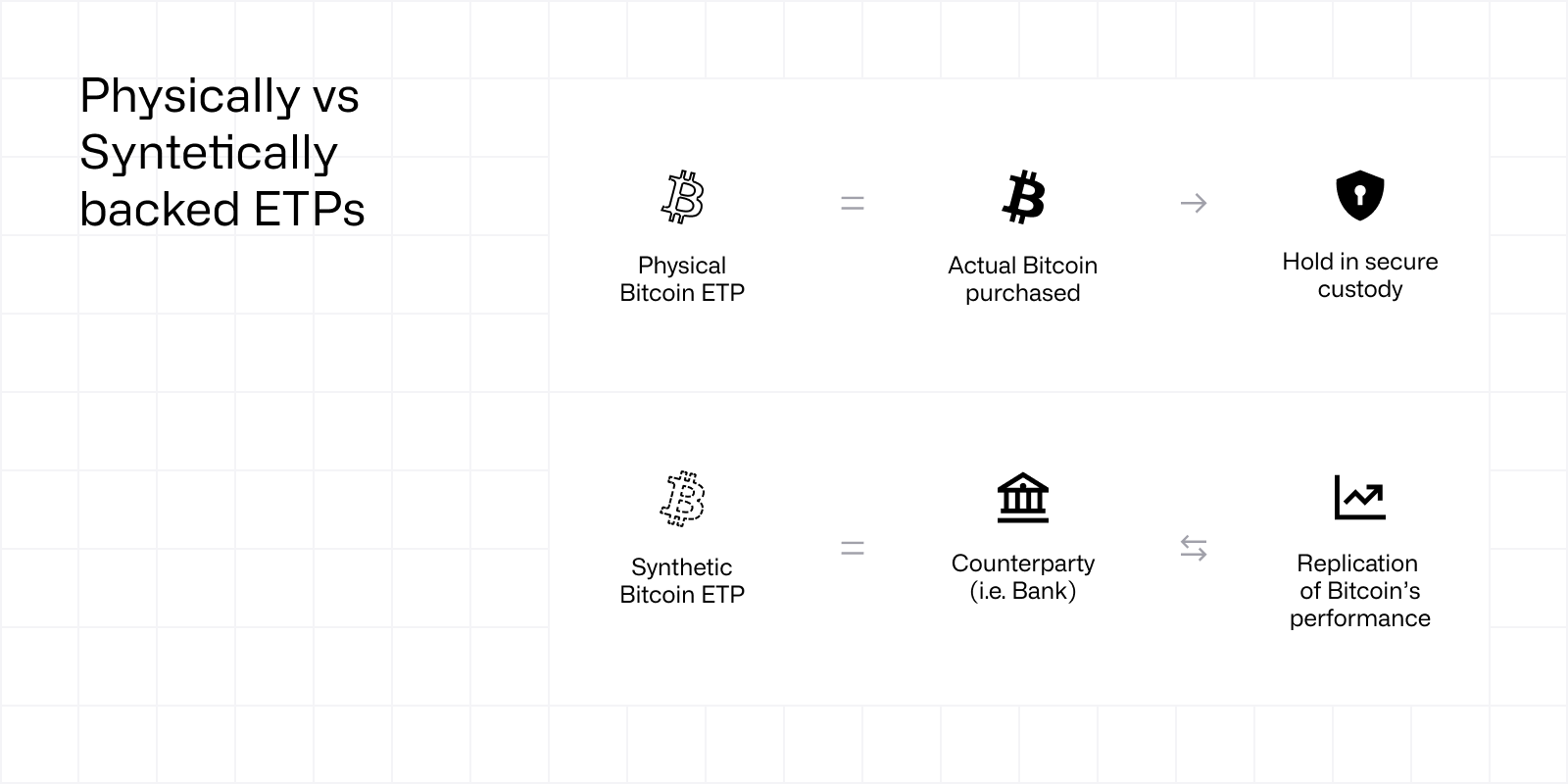
Crypto ETPs employ one of two replication methods: physical or synthetic.
Physical ETPs buy and hold the underlying cryptocurrency they are designed to track. For example, a physical Bitcoin ETP holds actual Bitcoin in secure custody. The performance of the product is directly linked to the price of the underlying asset. Given the simplicity of holding crypto digitally, the deep liquidity of major cryptocurrencies, and investor preference for transparency, the vast majority of crypto ETPs today are physically backed.
Synthetic ETPs use swap agreements with a counterparty (typically a bank) to replicate the return of the underlying asset. The counterparty is usually required to post collateral — often in the form of government bonds or blue-chip equities — to secure the arrangement. Synthetic structures have their place for assets that are difficult or costly to physically hold, but they introduce counterparty risk that physical products reduce.
In recent years, investor preference has shifted decisively towards physical products, particularly in the crypto space where transparency and proof of reserves are increasingly expected as standard practice.
How does a physical crypto ETP work?
To understand how a physical crypto ETP functions, consider a Physical Bitcoin ETP. Several parties work together to make it operate:
ETP Issuer — establishes a stand-alone special purpose vehicle (SPV) to issue the ETP. The product is then listed on a regulated exchange such as Xetra (Germany), Euronext (France and the Netherlands), SIX Swiss Exchange (Switzerland), or Nasdaq Stockholm (Sweden).
Trustee — represents the interests of investors. The issuer assigns all rights to the physical assets backing the ETP to the trustee, who acts as an independent safeguard ensuring the product is managed according to its terms and conditions.
Custodian — holds the underlying cryptocurrency in secure storage. Institutional-grade custodians use hardware security modules (HSMs), cold storage, and multi-signature protocols to protect assets.
Administrator — provides operational support and helps oversee day-to-day management of the ETP.
Authorised Participants (APs) — responsible for creating and redeeming shares of the ETP, ensuring the product trades close to the value of its underlying assets and maintaining market liquidity.
As an investor, you simply buy and sell the ETP on a stock exchange through your regular broker during trading hours — just like a stock. The value of the ETP rises and falls in line with the price of the cryptocurrency it tracks.
Do I actually own crypto when I buy a crypto ETP?
When you buy a crypto ETP, you do not own the cryptocurrency directly. Instead, you hold a debt security issued by the SPV, which is backed by the underlying crypto and secured through the trustee relationship. This structure is what makes crypto ETPs “bankruptcy remote” — the assets backing the ETP are ring-fenced and designed to be protected even if the issuer faces financial difficulty.
Some crypto ETPs also offer a physical redemption mechanism, whereby the registered holder can apply to receive the actual cryptocurrency in return for their ETP holding. This provides an additional layer of flexibility for investors who may want to take direct custody of their assets at some point.
What types of crypto ETPs are available?
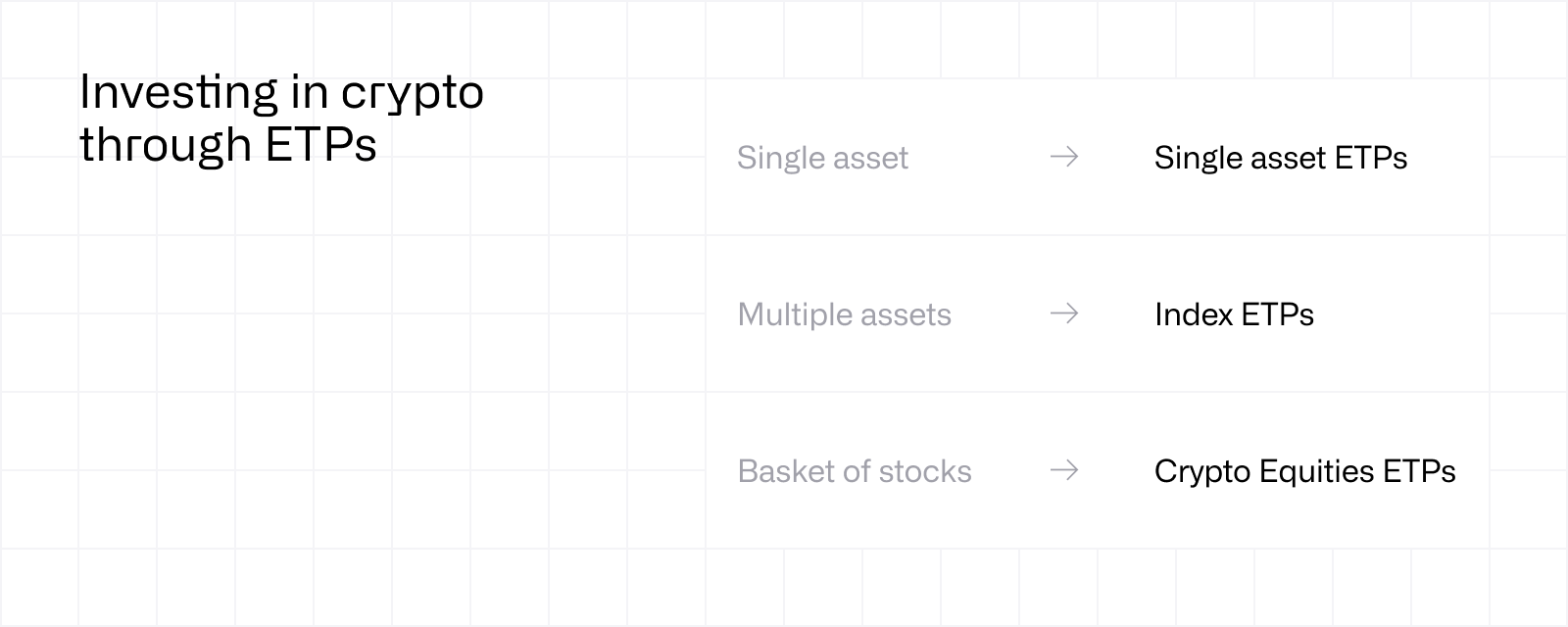
The range of crypto ETPs has expanded dramatically. As of early 2026, over 300 products are listed globally, covering:
Single-asset ETPs — track the price of one specific cryptocurrency. Bitcoin and Ethereum remain the most popular, but products now cover a wide range of assets including Solana, XRP, Cardano, Polkadot, Chainlink, and others. Single-asset ETPs can, depending on the asset, provide exposure to staking — a security participation mechanism that allows investors to benefit from rewards on proof-of-stake cryptocurrencies like Ethereum, Solana, and Cardano.
Index ETPs — track a basket of multiple cryptocurrencies, offering diversified exposure through a single product. These are automatically rebalanced at regular intervals to reflect changes in the market. For example, CoinShares Physical Top 10 Crypto Market ETP (CTEN) tracks the ten largest digital assets by market capitalisation, with a weighting cap of 35% per coin to reduce concentration risk.
Crypto equities ETPs — track baskets of stocks from companies involved in the cryptocurrency and blockchain industry, such as mining companies, exchanges, and blockchain developers. These provide exposure to the crypto ecosystem without holding digital assets directly.
How big is the crypto ETP market?
The crypto ETP market has undergone a structural transformation since 2024. A few key milestones:
January 2024: The US Securities and Exchange Commission (SEC) approved the first spot Bitcoin ETFs. This was a watershed moment — within months, these products attracted tens of billions of dollars in inflows and became among the most successful ETF launches in history. BlackRock’s iShares Bitcoin Trust (IBIT) alone held over $50 billion in assets by mid-2025.
Mid-2024: Spot Ethereum ETFs were approved in the US, further broadening institutional access to digital assets.
Full-year 2024: Global crypto ETP inflows reached a record $48.7 billion, according to CoinShares data, with total assets under management hitting approximately $160 billion.
Full-year 2025: Inflows remained strong at $47.2 billion — just 3% below the prior year’s record — while AUM rose to approximately $172 billion, according to data from Bloomberg. The year was marked by a notable rotation: Bitcoin ETP inflows declined 35% year-on-year, while Ethereum, XRP, and Solana products absorbed over $20 billion combined as investors diversified beyond Bitcoin.
In Europe, the market continued to develop, with $3.8 billion in annual inflows concentrated in Switzerland and Jersey. Major partnerships — such as CoinShares’ selection by BoursoBank (France’s largest online bank with over 7 million customers) to provide crypto ETPs — signalled growing mainstream adoption on the continent.
Why have crypto ETPs become so popular?
ETPs solve several practical problems for investors who want digital asset exposure:
Regulated access: Crypto ETPs are listed on regulated exchanges and supervised by financial authorities, providing a level of investor protection that direct cryptocurrency ownership does not.
No self-custody required: Investors do not need to manage wallets, private keys, or seed phrases. The underlying assets are held by institutional-grade custodians. This eliminates a common source of risk — user error, such as lost passwords or phishing attacks.
Portfolio integration: ETPs can be held alongside traditional investments in your existing brokerage account. In some jurisdictions, they may also be eligible for tax-advantaged wrappers.
Transparency: Leading ETP providers publish proof-of-reserves data, verified by independent third parties. For example, all CoinShares Physical ETPs are independently verified by The Network Firm, which uses blockchain technology to confirm the amount of crypto backing each product matches the issuer’s liabilities.
Competitive fees: Management fees on crypto ETPs have fallen significantly as the market has matured, with some products offering fees as low as 0% per annum.
How do I buy a crypto ETP?
Buying a crypto ETP is the same process as buying any stock or fund through your broker:
Log in to your online broker’s account or app.
Search for the product by name, ISIN code, or ticker symbol.
Choose the amount or number of shares you wish to buy.
Place your order and confirm the transaction.
CoinShares ETPs are listed on major European exchanges including Xetra, Euronext Paris, Euronext Amsterdam, SIX Swiss Exchange, and Nasdaq Stockholm — and are accessible through most mainstream brokers and investment platforms.
Key takeaways
An ETP (Exchange-Traded Product) is a financial instrument traded on a regulated exchange that gives investors exposure to an underlying asset without owning it directly.
Crypto ETPs come in several forms: single-asset trackers, index products, staking ETPs, and crypto equities ETPs.
The vast majority of crypto ETPs are physically backed, meaning real cryptocurrency is purchased and held in secure custody.
The crypto ETP market has grown rapidly, reaching approximately $172 billion in AUM by end-2025, with over 300 products listed globally.
Crypto ETPs offer regulated access, institutional-grade custody, portfolio integration, and transparency — making them a practical option for investors who want digital asset exposure through familiar financial channels.
Published onFeb 18th, 2026

Introduction to crypto
Crypto in the real world
Crypto investment options
Strategies and practical tips
