



Comprendre le CoinShares Bitcoin Mining UCITS ETF
 5 min de lecture
- Finance
- Mining
- Technologie
Le CoinShares Bitcoin Mining UCITS ETF (MINE) a été coté sur Deutsche Börse Xetra le 21 juillet 2026, offrant aux investisseurs européens un accès réglementé à un portefeuille de sociétés de Bitcoin mining pondéré selon la recherche. Voici comment cela fonctionne.
Les sociétés de Bitcoin mining constituent le cœur industriel du réseau Bitcoin. Elles convertissent électricité et matériel informatique en nouveaux bitcoins émis, et leurs actions sont négociées sur des marchés boursiers réglementés. Cette combinaison en fait une voie distincte d'exposition au bitcoin : une voie qui s'inscrit dans les marchés actions traditionnels plutôt que dans l'infrastructure crypto.
Avec la cotation du CoinShares Bitcoin Mining UCITS ETF sur Deutsche Börse Xetra le 21 juillet 2026, cette voie devient désormais accessible sous la forme d'une stratégie pure-play au sein d'une structure UCITS. CoinShares est la seule société de gestion à en proposer une. Ce guide explique ce qu'est le produit, comment l'indice sélectionne et pondère les mineurs, et pourquoi les actions liées au mining se comportent différemment du bitcoin lui-même.
Pourquoi les actions liées au mining
Les mineurs perçoivent leurs revenus en bitcoins, principalement via les récompenses de bloc, tout en réglant l'essentiel de leurs coûts – électricité et matériel, notamment – en devises fiduciaires. Cela crée un effet de levier opérationnel. Lorsque le bitcoin s'apprécie, les marges des mineurs ont historiquement progressé davantage que le prix du bitcoin lui-même, les revenus augmentant face à une base de coûts largement fixe. Le même mécanisme joue dans les deux sens : lorsque le bitcoin baisse, les marges se compriment plus vite que le prix, et les acteurs les plus fragiles peuvent se retrouver en difficulté. Les actions liées au mining doivent donc être comprises comme une expression amplifiée et opérationnellement sensible de l'exposition au bitcoin, non comme un substitut à la détention directe de l'actif.
Le secteur qui sous-tend ces actions est considérable. Le hash rate du réseau Bitcoin – la puissance de calcul totale qui le sécurise – s'établit actuellement à près d'un zettahash par seconde, avec des estimations quotidiennes sur les 30 derniers jours allant d'environ 0,8 à 1,1 zettahash et une moyenne sur 30 jours proche de 915 exahashs par seconde.1 Les mineurs ont perçu collectivement environ 849 millions de dollars sur les 30 derniers jours, dont environ 33,4 millions de dollars pour la seule journée du 19 juillet 2026, les récompenses de bloc représentant plus de 99 % de ces revenus.2 Depuis le halving d'avril 2024, la subvention par bloc s'élève à 3,125 BTC, et elle sera à nouveau divisée par deux vers 2028. Chaque halving réduit la principale source de revenus du secteur, ce qui explique précisément pourquoi la qualité opérationnelle, la discipline en matière de coûts et la solidité du bilan comptent autant dans la sélection des mineurs.
Le contexte macroéconomique a également évolué. L'approbation des ETF spot Bitcoin aux États-Unis, la création d'une réserve stratégique de bitcoins américaine, le GENIUS Act sur les stablecoins, le règlement MiCA en Europe et la montée des sociétés de trésorerie en bitcoin ont collectivement fait passer le bitcoin de la périphérie de la finance vers son cœur réglementé. Les actions liées au mining constituent la couche industrielle qui sous-tend cette évolution.
Ce qu'est le produit
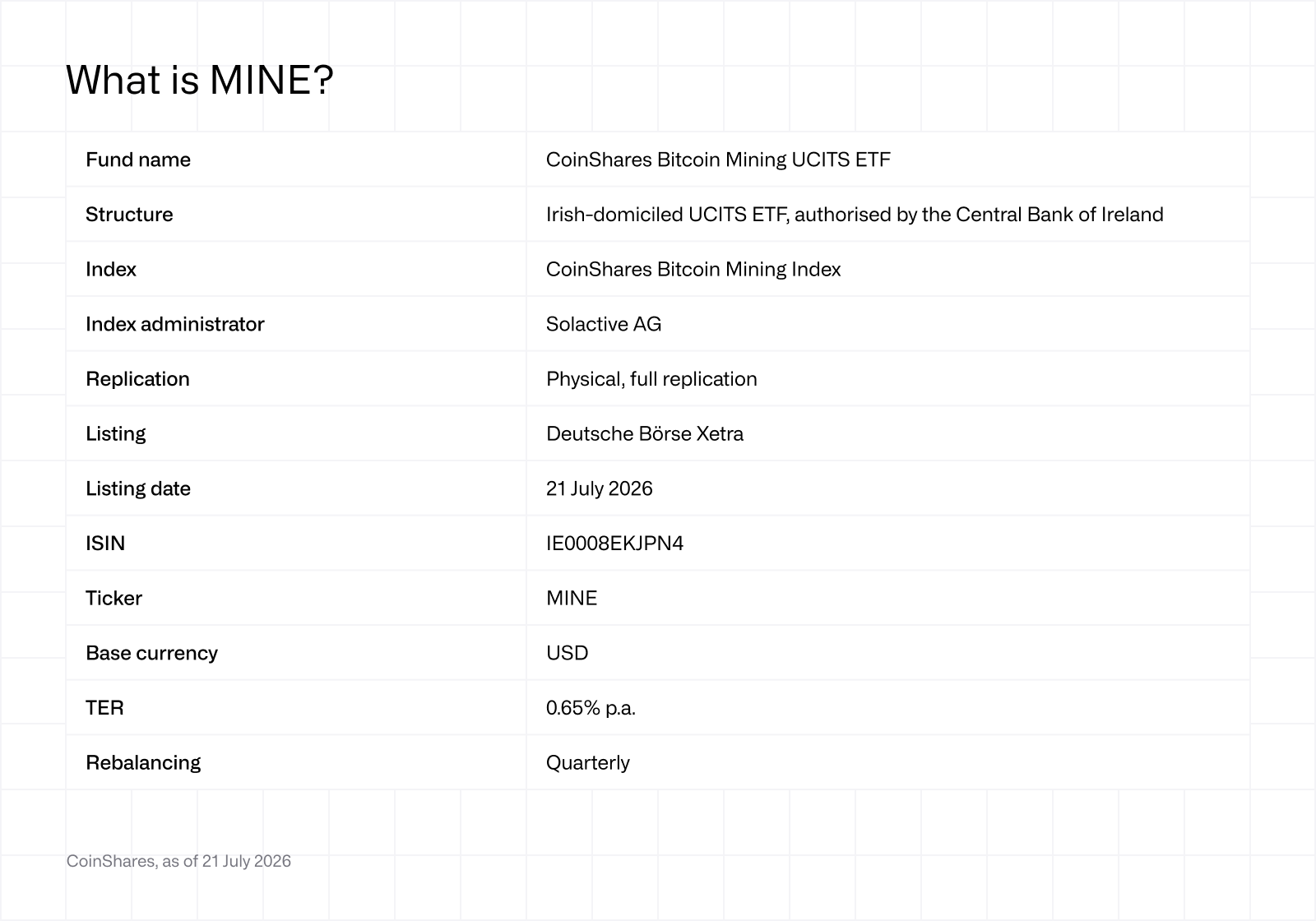
Le CoinShares Bitcoin Mining UCITS ETF est un ETF UCITS domicilié en Irlande, agréé par la Banque centrale d'Irlande. Il investit dans les actions des sociétés composant l'indice qu'il réplique, le CoinShares Bitcoin Mining Index, avec une réplication physique intégrale et aucune exposition synthétique.
Comment fonctionne l'indice
Le CoinShares Bitcoin Mining Index, administré et calculé par Solactive AG, n'est pas un classement par capitalisation boursière des mineurs qui se trouvent être les plus importants. Les constituants sont pondérés à l'aide d'un score de qualité CoinShares, construit sur dix années de recherche propriétaire sur le mining, incluant des visites sur site auprès des opérateurs miniers.
Le score évalue chaque société selon cinq dimensions. La première est l'ampleur et la croissance du hash rate déployé, c'est-à-dire la capacité productive brute qu'un mineur apporte au réseau. La deuxième est la rentabilité et l'efficience des coûts, mesurées par le coût de production par bitcoin et la marge opérationnelle, qui déterminent qui survit lorsque les marges se compriment. La troisième est la résilience financière : la solidité du bilan, la liquidité et la gestion de la dette, c'est-à-dire le coussin qui permet à un mineur de traverser les phases de baisse et les halvings. La quatrième est l'efficacité environnementale, centrée sur la part d'énergies renouvelables dans le mix énergétique d'un mineur. La cinquième est la gouvernance d'entreprise, qui couvre l'indépendance du conseil d'administration, la qualité du reporting et l'alignement avec les actionnaires.
La concentration est encadrée par un plafond de 18 % par valeur, pouvant être porté à 33 % pour le plus grand constituant, uniquement dans des circonstances exceptionnelles. L'indice est rééquilibré trimestriellement, de sorte que les pondérations sont régulièrement réajustées à mesure que le profil de qualité évolue.
Où il se positionne
Pour les investisseurs qui détiennent déjà du bitcoin ou un ETP Bitcoin, MINE offre une exposition complémentaire plutôt que redondante : une exposition actions aux opérateurs du réseau, avec l'effet de levier opérationnel, les conventions propres aux actions cotées (publication réglementée, comptes audités, négociation en bourse) et les risques sectoriels spécifiques qui l'accompagnent. Pour les investisseurs limités aux fonds actions, il offre une exposition liée au bitcoin au sein d'une structure UCITS familière.
Il s'agit d'une exposition sectorielle concentrée et à forte volatilité, qui doit être calibrée en conséquence au sein d'un portefeuille diversifié.
Initialement disponible sur des marchés européens sélectionnés. La disponibilité peut varier selon le pays et le type d'investisseur.
Principaux risques
Les sociétés de Bitcoin mining sont fortement exposées à la volatilité du prix du bitcoin et font face à des risques opérationnels, réglementaires, ESG et de cybersécurité significatifs. Il n'existe aucune garantie en capital : les investisseurs pourraient perdre tout ou partie de leur investissement. Avant d'investir, veuillez consulter la section Facteurs de risque du prospectus ainsi que le document d'informations clés (KID), disponibles gratuitement sur coinshares.com.
Sources
1. Blockchain.com, 20 juillet 2026
2. Token Terminal, 20 juillet 2026
Publié leJuil 28th, 2026
